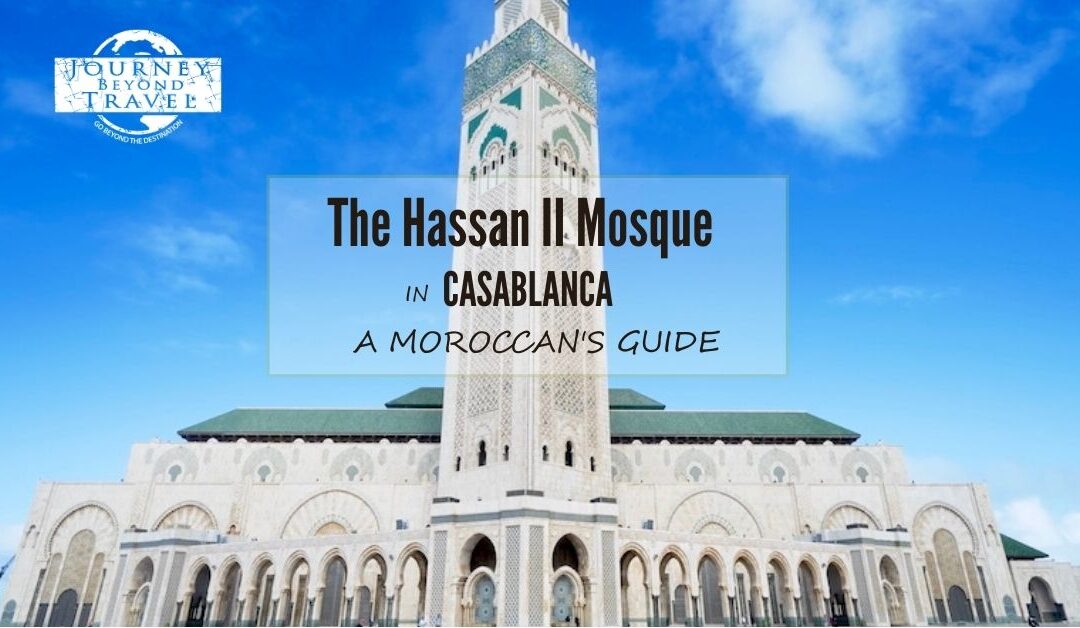
For much of the world outside Morocco, Casablanca brings to mind Humphrey Bogart, Ingrid Bergman, and all that classic bygone era of noir romance. But as a Moroccan, Casablanca is the beating heart of our nation, a city full of energy and ambition. And somewhere in this city, over the Atlantic Ocean, standing sentinel with a lot of grace and pose: the Hassan II Mosque.

As one of Morocco’s most iconic landmarks, the Hassan II Mosque is also one of the few mosques in the country that warmly welcomes non-Muslim visitors, making it a rare and genuinely meaningful stop for anyone looking to visit Casablanca and connect with Moroccan history, culture and Islamic heritage.
I myself hadn’t really planned to visit that day. It was one sunny morning, after spending a couple of days visiting family, that I decided to take a detour from the city’s usual crowdiness. The little red taxi went through the wide boulevards, and as we moved away from the denser area of the city, we arrived next to an enormous open space. And there it was, you can’t miss it, a beautiful mosque carved in marble, granite, and wood. Even from a distance, the minaret, rising high above everything else, immediately grabbed my attention.
Both my parents told me the story of how everyone chipped in to build the mosque. They told me even ordinary people contributed what they could, whether it was farmers or merchants like my grandparents. My grandparents on both sides did their part. Their contribution was expected, and from what I hear, they did it with immense joy.
I thought perhaps I’ll arrive with a detached admiration, but it was quite the opposite. There’s a certain intimacy in knowing that a few dirhams given by your grandparents helped lay these very foundations. And there I was looking at a mosque built by the collective will and contributions of millions of Moroccans. And it was indeed magnificent, if there’s one testament to our shared identity as Moroccans, then this should be it.
Can you visit Hassan II Mosque as a tourist?
Yes, absolutely, and it’s one of the very few mosques in Morocco open to tourists.
Most mosques across Morocco are not accessible to non-Muslims, which makes the Hassan II Mosque a genuinely rare opportunity. Visiting mosques as a tourist in Morocco typically means admiring them from the outside, so being welcomed in is something you don’t take for granted.
Entry is only permitted as part of a guided tour, so you won’t be wandering around independently. Your guide will lead the group through the main spaces, explain the history and architecture, and let you know what’s appropriate at each point during the visit. It’s a structured experience, but not a rigid one, there’s still plenty of room to absorb the atmosphere at your own pace.
A note on Morocco cultural etiquette: the mosque remains an active place of worship. Visitors are expected to be respectful of that, quiet voices, no rushing, and following your guide’s lead. Most visitors find this comes naturally once they’re inside.
What to Wear When Visiting Hassan II Mosque
Before you step inside, it’s good to know a few simple dress guidelines for your visit. The mosque dress code in Morocco follows the same principles you’d apply at any religious site: modest, covered and respectful. For both men and women, shoes have to be taken off at the entrance. As in all mosques around the world, you can’t wear your shoes in the mosque. There are little plastic bags to put your shoes in, which you can keep with you while touring the mosque. I was glad I’d worn socks as we walked across the cool marble floors, though the mosque is so well-maintained that going barefoot wouldn’t be uncomfortable either.
Us ladies, well, we have to cover our hair. I don’t wear a hijab so, probably like me, you can just take one of the scarves available at the entrance for hair cover during your visit to be respectful. Otherwise, make sure to wear shirts that cover your shoulders and chest, and longer pants or skirts that go below the knees.
The general rule: when in doubt, cover more rather than less. It’s a small adjustment that goes a long way in showing respect for the space.
Photography at Hassan II Mosque
During guided tours, visitors can take pictures in the main areas. I was able to capture some of the details that captivated me, like the zellij mosaics and the carved cedarwood. However, there are important guidelines to follow. For example, you should never take pictures of worshippers without their explicit permission. Your guide will let you know when and where photography is appropriate during your tour. The ocean view from the exterior is one of the best shots you’ll get, the mosque sits right on the waterfront, and on a clear day the combination of white marble and open sea is hard to beat. Just remember to be mindful and respectful, following your guide’s instructions and being considerate of other visitors.

*Traveler’s Tip: Arrive early in the day when the lighting inside is best and crowds are smaller. The morning light streaming through the hallways creates incredible effects on the marble and zellij work that you won’t see later in the day. Late afternoon light works well too, especially if you want the minaret lit up against the sky.
Facts About the Hassan II Mosque
As I walked into the plaza, I was struck by how grand the mosque really was. You can hear the Atlantic Ocean crash against the seawall, a loud counterpoint to the quiet grandeur of the mosque. King Hassan II’s vision, inspired by the Quranic verse, “His throne was upon the water,” couldn’t have been captured better. The mosque extends over the ocean, with a glass floor section (though primarily for royal use and not accessible to visitors) that allows for prayer over the water. It’s breathtaking in every sense of the word.
At 210 meters (689 feet), its minaret was, for a time, the tallest in the world, and remains one of the tallest today. It’s visible from much of the city and from out at sea.
The mosque can accommodate an astonishing 105,000 worshippers: 25,000 inside the prayer hall and another 80,000 on the vast exterior plaza. I can only imagine when everyone gathers for prayer, thousands bowing together in a sea of humanity, perfectly in sync.
What to Expect During Your Visit
The artistry is what really got to me, every surface, and every curve carved to perfection, in a way that really captures Moroccan, Andalusian and Islamic architecture. The materials themselves come from Morocco’s rich natural resources. Cedarwood from the Middle Atlas Mountains, marble from Agadir, granite from Tafraoute. Only the grand chandeliers from Murano, Italy, and a few white granite columns were imported, which adds a rather sophisticated touch that complements the ocean view.

As I entered the prayer hall, guided by a soft-spoken local guide, I sensed an immediate feeling of tranquility. I could see the effort of thousands of maalems (master craftsmen) and artisans who poured their hearts and souls into this project, working tirelessly for years. I could see it in the stunning zellij mosaics that adorn the walls and columns, in the geometric patterns in a vibrant palette of pale blues, greens, and yellows, and in how each tile is carefully hand-cut and laid.
The tadelakt plasterwork was my favorite detail, historically used in hammams for its waterproof quality. It worked surprisingly well on the columns and walls of the mosque, its smooth, lustrous finish glows under the diffused light coming into the hallways. The closer you look, the more you discover. Delicate floral motifs, calligraphic verses sculpted with incredible detail, and carved cedarwood ceilings. So wherever your eyes wander, you’ll find something worth noticing. In fact, you can use the hammam at the mosque; this time I didn’t, but it’s definitely something to consider.

The Mosque’s Unique Details You Might Miss
The mosque has two basements that were turned into ablution halls. As you walk in, you can smell the scent of wood mingling with the faint aroma of the sea and the cool marble underneath. It has more than 40 ablution fountains. Shaped like giant lotus flowers and made from locally sourced marble, which are all beautiful pieces of work.
My guide pointed out a few details that I would’ve otherwise missed. Like the retractable roof, a very nice and innovative feature that opens to the sky on special occasions. In a way, it allows worshippers to connect directly with God. He also mentioned the underfloor heating, a subtle but important touch, that ensures comfort even on the chilliest winter days. I couldn’t help but notice how everything was thought through. At the end of the day, it’s this mixture of tradition and innovation that makes the Hassan II Mosque truly one of a kind.
The Academy of Traditional Arts
What struck me the most, however, was the passion that went into creating it, even more so than the mosque’s incredible beauty. This mosque is a living monument to the preservation of traditional Moroccan arts. And this dedication luckily continues to this day, right next to the Mosque itself. The Academy of Traditional Arts (Académie des Arts Traditionnels). Since 2012, this institution has been training young Moroccans in the very crafts that built the mosque. The academy covers 10 sectors such as zellij, carved wood, ironwork, leatherwork, jewelry, and calligraphy. Students spend years learning from master artisans, who ensure that these centuries-old techniques are passed down to new generations.
Visiting the mosque, I realized the importance of this institution. We must do more than admire our heritage; we have to actively continue and keep it alive. It’s comforting to know that these skills won’t die out. Young hands will continue the future of these arts. In a continuous cycle, where the past informs the present, which in turn safeguards the future.
Before You Go
A few practical details to help you plan:
Location: The mosque sits on the Casablanca waterfront, on Boulevard Sidi Mohammed Ben Abdallah. It’s easy to reach by petit taxi from most parts of the city.
Hassan II Mosque opening hours and tickets: Tours for non-Muslim visitors typically run in the morning, from around 9 AM, with multiple departure times. Tickets are purchased on site. We recommend checking current prices and tour times directly with the mosque or through your tour operator before you visit, as these can change.
Best time to visit: Morning, both for the light inside and the smaller crowds. On Fridays, it’s only open for a few hours because of the Friday prayer.
Nearby restaurants: The Corniche area along the waterfront has a solid range of options. La Sqala, located in a historic bastion near the old medina, is a local favorite for Moroccan food and atmosphere. The Ain Diab district, a short taxi ride away, has more casual waterfront options.
How to visit the Hassan II Mosque in Casablanca: If you’re visiting independently, head to the mosque entrance and join one of the scheduled tours. If you’re traveling with a guide or tour operator, they’ll typically handle the logistics and can add context that makes the visit considerably richer.
Why Hassan II Mosque Should Be on Every Morocco Itinerary
If you’re putting together a list of things to do in Casablanca, this is the one that earns its place on every version of that list. As i was leaving the mosque, the ocean breeze seemed to carry more than just the scent of the sea or the call to prayer. But also the pride of an entire nation and preserved heritage. As for you, dear future visitor, I hope it’s an invitation to feel, to understand, and to observe a magnificent building and the hard work of everyone who made this possible. A mosque that will stand tall for generations to come and will continue to tell its story gracefully right next to the Atlantic Ocean.
Planning a Longer Morocco Trip?
The Hassan II Mosque is a strong starting point — but Casablanca has a lot more to give.
- Casablanca Habous Quarter— how to structure your trip from north to south
- Casablanca Travel Guide — the full picture on what to do, where to eat, and how long to stay
- Moroccan Jewish Museum — if you want to go deeper into the city beyond the mosque
- Things To Do In Casablanca — Morocco travel stories, tips, and itinerary ideas from people who know the country well
About the Author

Ahlam Morjani is a Tangier-based writer, aspiring psychologist, and devoted animal lover. When she’s not immersed in her work or studies, she’s exploring the intersections of cinema, philosophy, and self-development through her articles.
She loves to spend her quiet days feeding the city’s strays that roam the medina’s narrow streets or settling into the worn velvet seats of Tangier’s old cinemas, finding profound inspiration within these spaces that resonate with her explorations into film and art, societal nuances, and the very joie de vivre of life itself.
Photos by Lucas Peters. Lucas is the principal photographer and author of the Moon Guidebooks: Morocco as well as Marrakesh and Beyond published by Hachette. He edited and contributed to the Our Morocco anthology and helps the travelers of Journey Beyond Travel experience the adventure of a lifetime. He lives in Tangier with his family.