In 2021, we made a decision that fundamentally changed the way we think about travel and what it leaves behind. We partnered with the High Atlas Foundation to pilot a program that doesn’t stop at carbon offsetting and actively give back to the grid for every tour we facilitate.
This was not about greenwashing or symbolic gestures. We wanted to take accountability. First, by asking a difficult question: If travel inevitably leaves a footprint, what does it look like to repair more than we take?
Reimagining Development from the Ground Up
In a world where large development agencies often prescribe solutions to communities, the High Atlas Foundation (HAF) stands out by redefining development with communities. Founded in 2000 by former Peace Corps volunteers, HAF operates at the nexus of participatory design and ecological resilience across Morocco’s rural communities and landscapes.
At its core, the High Atlas Foundation rejects traditional, top-down approaches. Rather than imposing external blueprints, HAF equips local communities (especially women and youth) with the tools to identify their priorities, design their own initiatives and oversee implementation.
This philosophy of participatory development is embedded in every stage of HAF’s work. Local voices shape decisions that touch agriculture, water consumption and cultural preservation.
Why We Chose the High Atlas Foundation
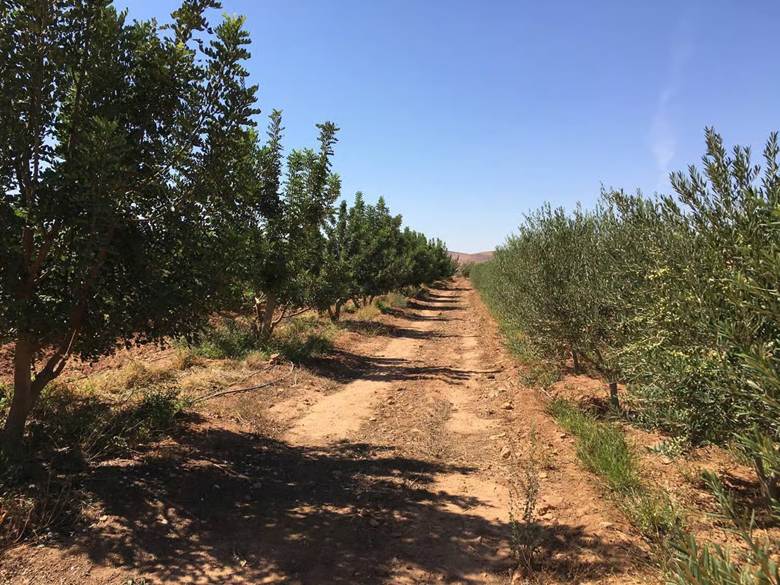
Our collaboration with the High Atlas Foundation was intentional. Their work reflects a philosophy we share: sustainable change begins with local agency, not external agendas.
As Yossef Ben Meir, co-founder and president of the High Atlas Foundation, explains in his 2020 TED Talk, development only works when it is rooted in what communities themselves identify as priorities. “We listen to the people,” he says. “And we base our projects on what the people identify and prioritize.”
This approach explains why tree planting, particularly fruit trees, consistently emerges as a priority in rural Morocco. As Ben Meir notes, nearly 70% of Morocco’s agricultural land generates only a small fraction of agricultural income, largely because farmers rely on low-yield cereal crops. Fruit trees, by contrast, allow families to transition toward higher-value, diversified and more resilient livelihoods. “The people wanted to transition to fruit tree cultivation,” he explains, “because barley is important, but it’s not meeting their needs.”
The foundation works directly with rural communities across Morocco on initiatives such as:
- Community-managed tree planting and organic fruit tree nurseries
- Regenerative agriculture and land restoration
- Women-led cooperatives and income-generating projects
- Community-driven development shaped through participatory decision-making
Crucially, this work is not designed in isolation from the communities it serves. Ben Meir emphasizes that Morocco’s legal framework already mandates participatory development, requiring municipalities to create development plans based on citizen input. The challenge, he argues, is not a lack of policy, but a lack of practice. “We have exceptional laws,” he says, “but their fulfillment is not yet at the level we need.”
The High Atlas Foundation runs on a simple premise: the people who live on the land should decide what happens to it. “Entrepreneurship,” Ben Meir argues, “comes when communities identify the projects that are in their priority.”
Development, in this sense, becomes collective rather than extractive.
These trees feed people first. They sit inside working farms, owned by the families who tend them. It provides food, income, something to pass down. Environmental benefits follow from that foundation, rather than being treated as the primary metric of success.
Understanding the Environmental Cost of Travel
Most carbon offset programs stop at flights. At Journey Beyond Travel, we chose to go further.
We took the time to account for our travelers’ comprehensive carbon footprint, including:
- International flight to/from Morocco
- On-the-ground transportation
- Electricity use assuming a mix of solar where possible in some of our boutique accommodations
- Food consumption (assuming typical Moroccan meals like chicken tajine and lamb couscous)
- Laundry and bottled beverages (including alcohol and water)
Based on these calculations, we estimate that each traveler emits approximately 1.85 tons of CO₂ during their trip in Morocco.
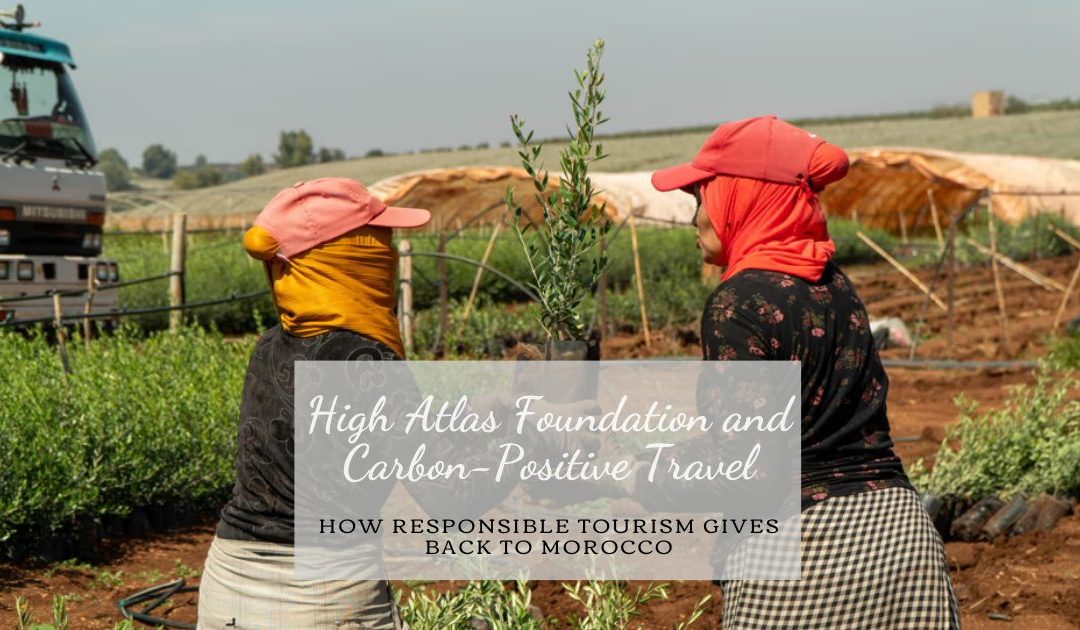
To address this impact, we contribute to tree planting initiatives in partnership with local farming families through the High Atlas Foundation. For each traveler, we plant approximately 34 trees. Over a five-year period, these trees are estimated to absorb around 0.85 tons of CO₂.
Because these trees are planted as part of long-term community programs, they are not tracked under formal carbon crediting schemes that require decades of third-party monitoring. As a result, their contribution is best understood as carbon mitigation rather than a precisely quantified offset.
In practical terms, these initiatives are estimated to mitigate a significant portion of the emissions associated with the journey, while delivering measurable benefits on the ground for farming families and local ecosystems. The environmental value is inseparable from the social one: healthier landscapes, more resilient livelihoods and land managed by the people who depend on it.
This is a deliberately conservative and transparent approach. Instead of reducing impact to abstract numbers, we focus on interventions that address emissions while strengthening the communities and environments our travel relies on.
Travel, in this model, becomes regenerative and sustainable.
Traveler Donations That Multiply Impact
Since 2011, we have invited travelers to contribute directly to the High Atlas Foundation at the time of booking. That commitment continues.
In addition to a built-in fee per tour, every voluntary donation made by our travelers goes directly to the foundation, and we match all contributions. This means that individual choices, often made during the booking process, double in impact once they reach the ground.
For us, this practice reflects a belief that ethical travel should be participatory. Travelers are not passive observers. They become collaborators in regeneration and ultimately, in human development.
Sustainable Tourism That Feels Personal
What makes this partnership between the High Atlas Foundation and Journey Beyond Travel meaningful is that it does not abstract responsibility.
When you travel with us, your journey supports:
- Trees planted in Moroccan soil
- Local families earning income through sustainable initiatives
- Communities building long-term resilience rather than short-term aid dependency
Sustainability for us does not stop at emissions accounting. We intentionally hand-pick and work with partners selected for their commitment to community engagement and long-term environmental responsibility.
Journey Beyond Travel is a boutique, family-owned company offering immersive, carefully designed experiences. Our aim is to create travel that is thoughtful, transparent and aligned with our values and with the broader goals of inclusive development and environmental responsibility.
We do not claim to be perfect. We see sustainability as an ongoing practice, one that requires constant reassessment and improvement.
The goal is simple: to experience Morocco deeply, while contributing positively to the places and people who make that experience possible. And our hope is to enlarge the scope of our impact into other destinations we explore.
Travel with care. Leave things better than you found them. That, to us, is what responsible travel looks like.
Supporting Sustainable Tourism and Communities in Morocco
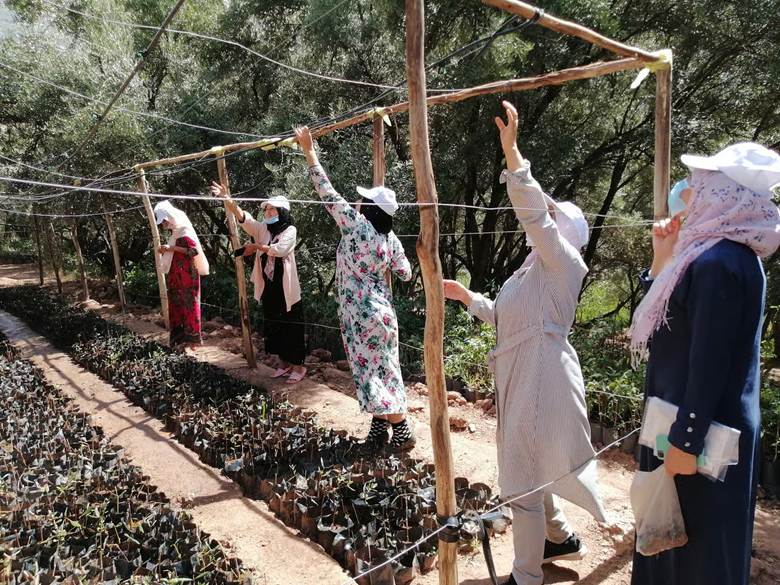
The High Atlas Foundation’s work reminds us that sustainability is not only environmental. It is social, economic and very much human. The Foundation has seen what happens when outside organizations design programs for communities instead of with them. The trees die. The project folds. Everyone moves on except the people left with the land. What Ben Meir has built is slower and more stubborn. It survives because the people who live on that land were the ones who decided to plant it.
If you want to explore the work of HAF in more depth, you can visit their official website here:
https://www.highatlasfoundation.org
About the Author

Ahlam Morjani is a Tangier-based writer, aspiring psychologist, and devoted animal lover. When she’s not immersed in her work or studies, she’s exploring the intersections of cinema, philosophy and self-development through her articles.
She loves to spend her days feeding the city’s strays that roam the medina’s narrow streets or settling into the worn velvet seats of Tangier’s old cinemas, finding profound inspiration within these spaces that resonate with her explorations into film and art, societal nuances, and the very joie de vivre of life itself.