“Before Marrakech, everything was black.” — Yves Saint Laurent
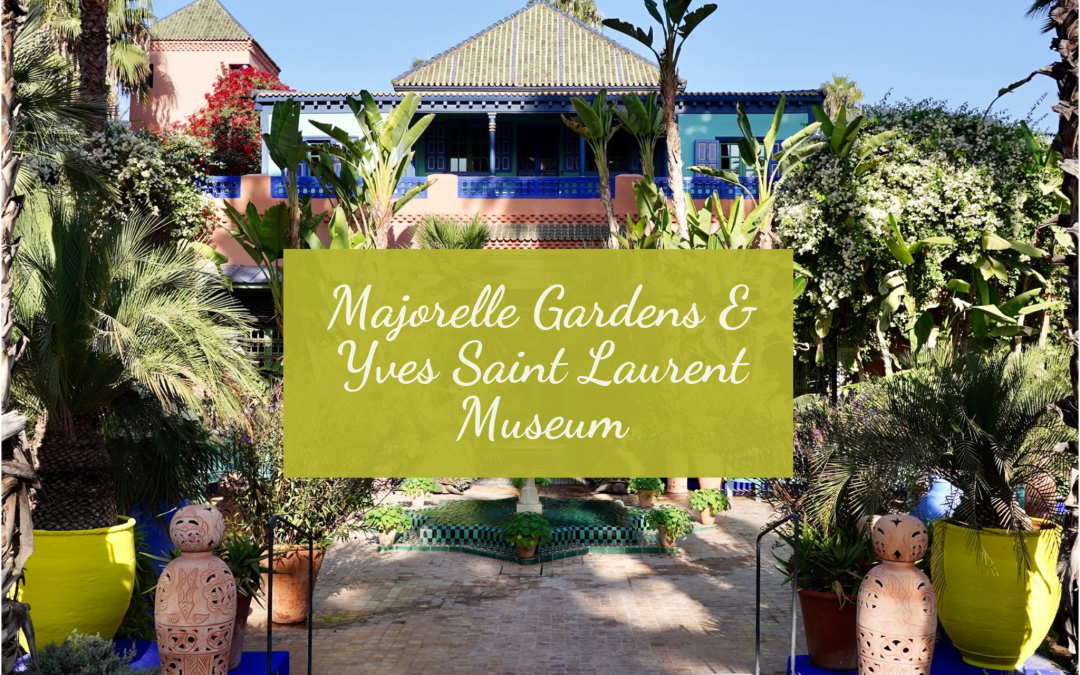
There are places that seem to hold a rhythm all their own. You step inside, and the noise of the world softens. The heat of the city gives way to something much gentler…cool shade, birdsong, and the trickle of water through narrow marble channels. Majorelle Garden, in the heart of Marrakech, is one such place.
A lucid dream in a desert city, this 12-acre garden has inspired painters, poets, designers, and wanderers for nearly a century. Its deep, electric hue. Majorelle blue has become iconic, adorning walls, fountains, and archways in a color that seems to glow beneath the Moroccan sun. But Majorelle Garden is more than a feast for the eyes. It’s a love story between art and nature, and between two men whose creative partnership would leave a lasting mark on Marrakech.
Jacques Majorelle and the Creation of Marrakech’s Iconic Jardin Majorelle
Long before Yves Saint Laurent discovered Marrakech, a French artist named Jacques Majorelle did. Born in 1886, Majorelle was the son of a celebrated Art Nouveau furniture designer in Nancy, France. He studied painting in Paris, traveled through Egypt, and eventually settled in Morocco in 1919, captivated by its light, its rhythms, and its colors.
In 1923, he purchased a parcel of land on the edge of what was then the palm oasis outside Marrakech’s medina. Over the next forty years, Majorelle poured his life into transforming the arid plot into a botanical wonderland. He filled it with exotic species gathered from his travels: bamboo from Asia, cacti from the Americas, palms from the Caribbean, and bougainvillea from the Mediterranean.
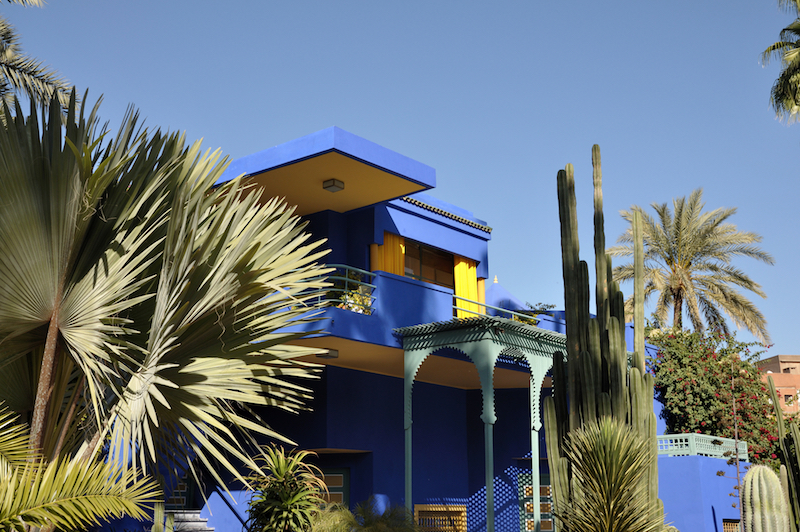
At the centre, he built a Cubist-style villa designed by French architect Paul Sinoir, modernist in form, yet unmistakably Moroccan in soul. He covered it in a searing ultramarine, later known as Majorelle Blue. The shade drew inspiration from Morocco itself: the indigo robes of the Tuareg, the shimmering zellige tiles of Fez, and the vast ocean that links this country to the wider world.
Majorelle called his creation the Jardin Majorelle, and it became his greatest masterpiece. Yet for all its beauty, it was also fragile and dependent on the care and vision of its creator. After Majorelle’s death in 1962, the garden languished. The fountains dried up. The bamboo wilted. The once-vibrant blue faded under the relentless sun.
How Yves Saint Laurent and Pierre Bergé Rediscovered Marrakech’s Majorelle Garden
Then came Yves Saint Laurent and Pierre Bergé. The year was 1966. The two had come to Morocco seeking escape from busy Paris. A place to breathe, to create, to rest. Marrakech was hardly the jet-set destination it is today. It was dusty, chaotic, intoxicating, and, as Bergé later recalled, utterly transformative.
“When we first found the Majorelle garden, it was in ruins,” Bergé said in an interview years later. “But we fell in love instantly. “We decided we could not let this garden disappear.”
The pair purchased the property in 1980, restoring it with meticulous devotion. They revived Majorelle’s original plantings, reintroduced fountains, and brought back the deep cobalt color that defined the space. The garden’s pathways were repaved, its pools scrubbed, its palms trimmed and re-planted. They turned what was once a forgotten relic into a living masterpiece once more.
Their connection to Morocco ran deep. Saint Laurent spoke of the country not merely as a muse but as a turning point in his life and art. “Before Marrakech, everything was black,” he once said. “Marrakech taught me color.” The ochres of the medina, the pink of its clay walls, the emerald of the palms, and, of course, the blue of Majorelle, all seeped into his collections for decades to come.
The couple made Marrakech their home away from home, living in a nearby villa they called Dar el Hanch (House of the Snake). They entertained friends, artists, and designers: Loulou de la Falaise, Catherine Deneuve, Andy Warhol, all drawn to the city’s creative pulse and languid pace.
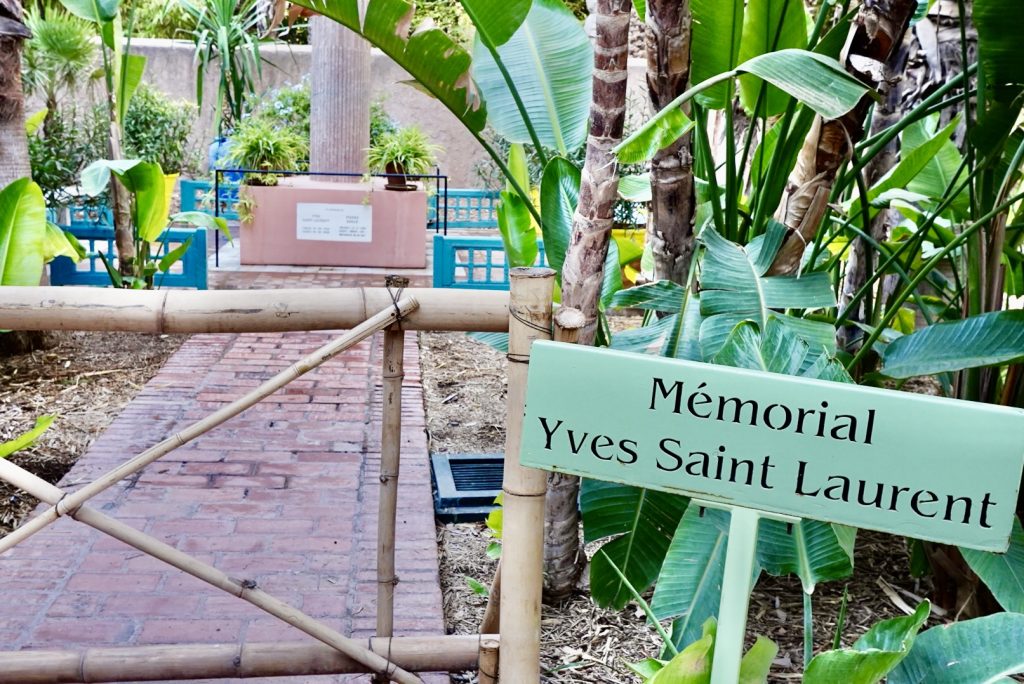
When Saint Laurent passed away in 2008, his ashes were scattered among the bamboo groves of Majorelle Garden. A simple Roman column now marks the spot. A quiet corner for reflection within the riot of color.
Exploring the Jardin Majorelle: Marrakech’s Most Enchanting Garden
Entering Majorelle Garden today feels like stepping into a whole other world. The bustle of Marrakech fades as soon as you cross the cobalt gates. Paths wind through towering palms and dense clusters of bamboo. Marble pools catch the light and reflect a canopy of green. Birds flit through the trees: bulbuls, warblers, turtledoves, and wagtails, filling the air with song.
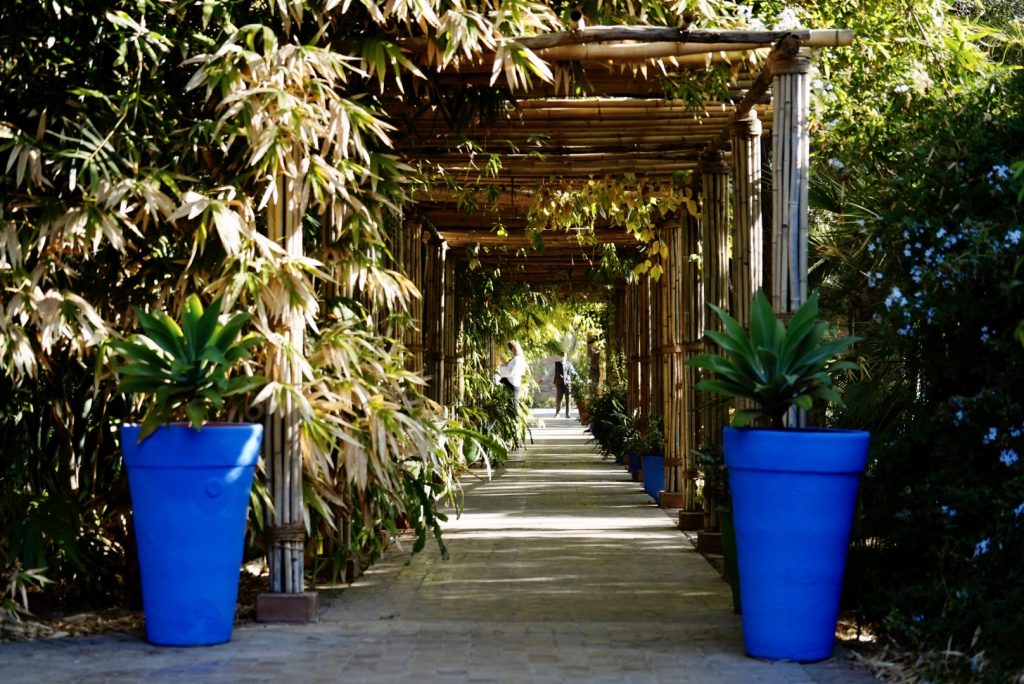
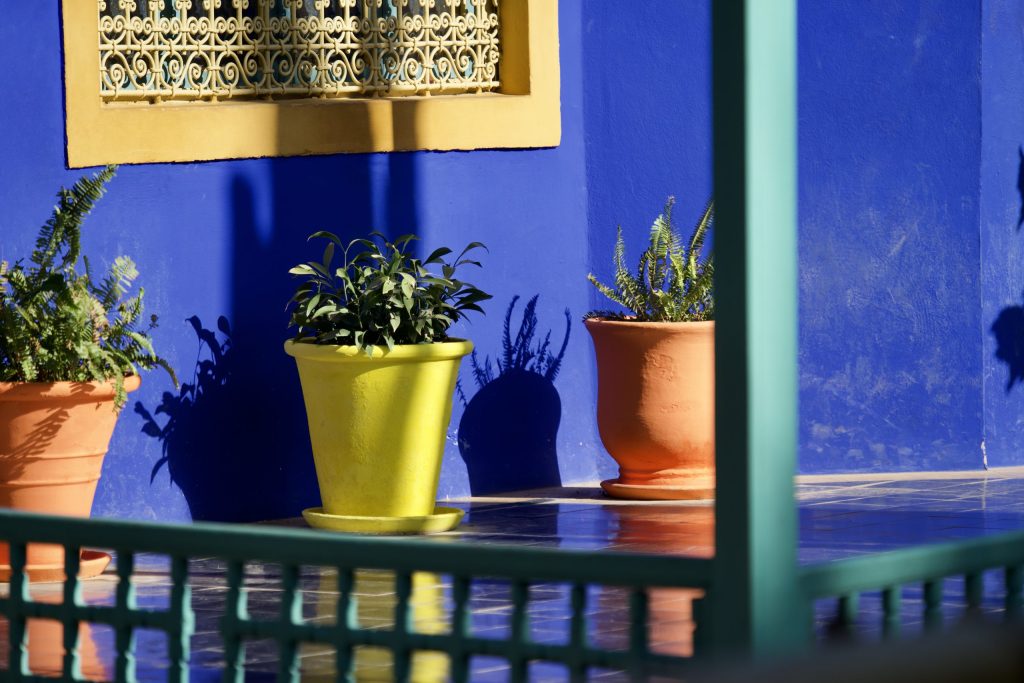
Every corner reveals a painter’s sense of proportion and contrast. Yellow pots line the paths. Cacti rise like sculptures against the blue walls. Fountains bubble quietly in the shade. It’s lush but never wild.
Majorelle once described his garden as a “living work of art” that he built “around a central canal and exotic plants”. That spirit remains. Whether you’re an artist, photographer, or simply a wanderer seeking stillness, it’s easy to lose hours here, lulled by the rhythm of water and birdsong.
The Color That Changed the World
Few places in Morocco have contributed so directly to global design as the Jardin Majorelle. The blue that bears its name has entered art history as one of the most recognizable hues on earth. It’s not the cool blue of the Mediterranean nor the pale tint of Moroccan tiles. It’s deeper, almost electric, and shifts subtly with the light.
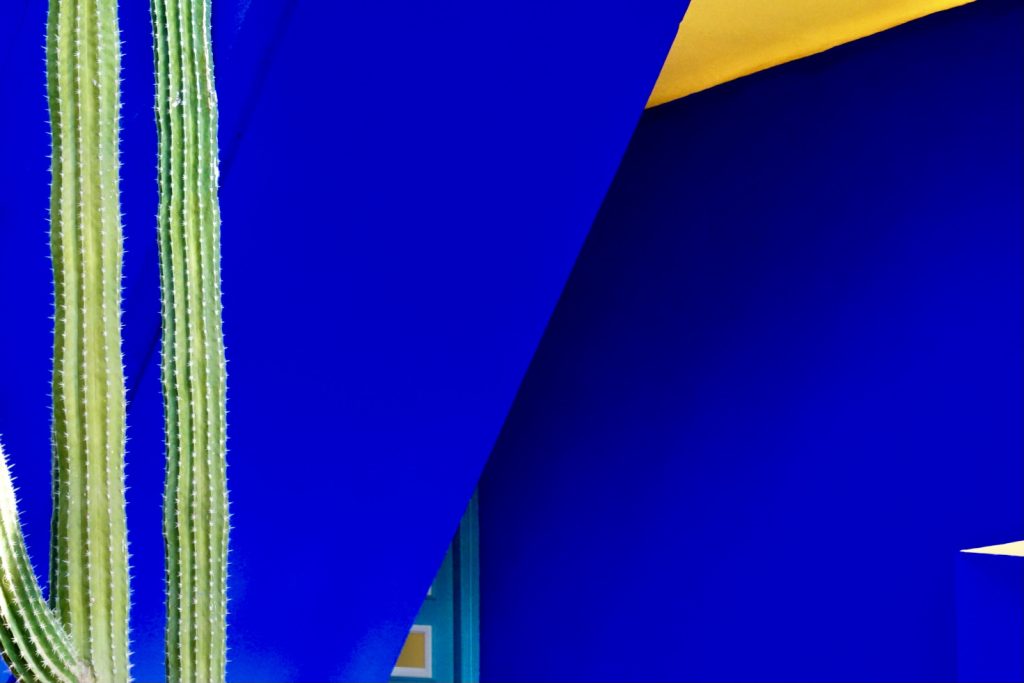
Majorelle Blue is mood. Under the midday sun, it glows like fire. At twilight, it turns velvet. It’s a color that feels alive, one that refuses to separate the subject from the object.
When Saint Laurent and Bergé revived the garden, they safeguarded this color’s legacy. Today, visitors from around the world photograph its walls, buy scarves dyed to match, and leave wearing a trace of that cobalt calm.
It’s one of the few shades that can only truly be understood in place. In the soft air of Marrakech, amid palms and fountains, under the long afternoon light.
The Yves Saint Laurent Museum
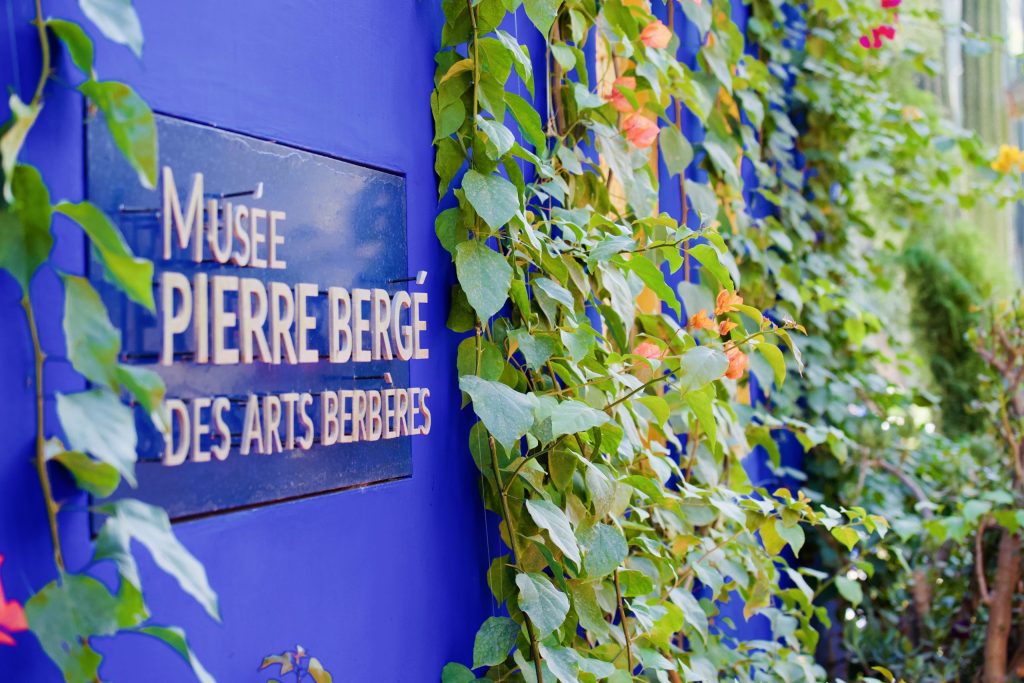
Just beyond the garden walls stands another masterpiece of color : the Musée Yves Saint Laurent Marrakech.
Opened in 2017, it’s less a museum than a continuation of the garden’s spell: a space where fashion, art, and Morocco become one.
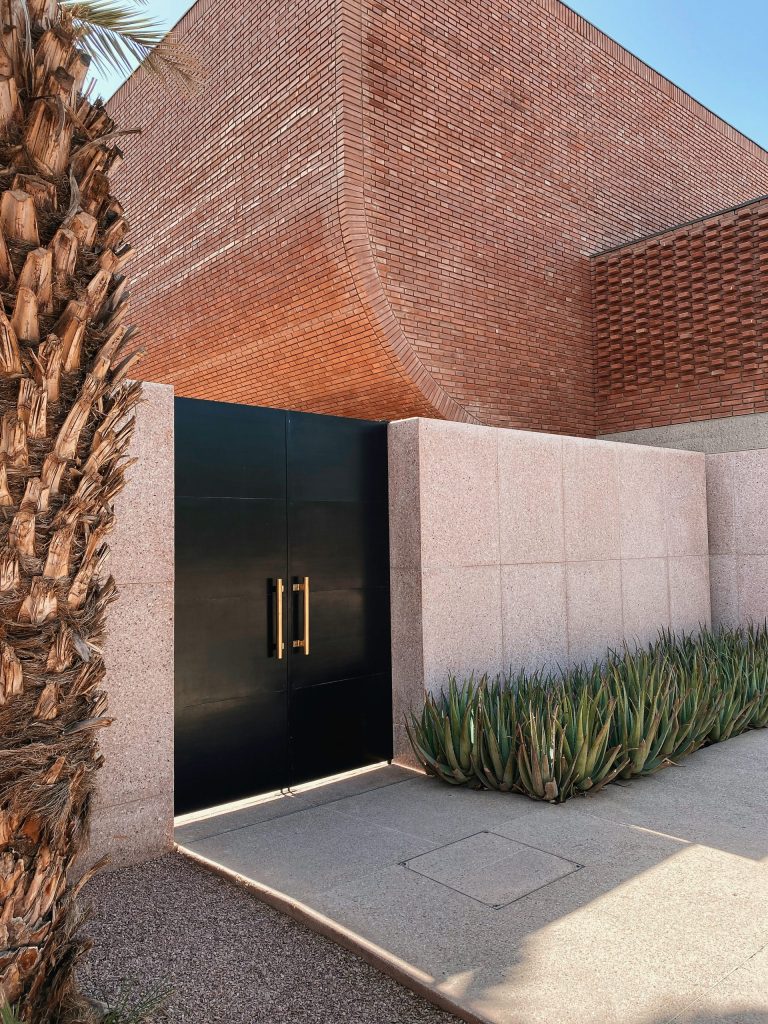
The building, designed by the French duo Studio KO, seems to rise from the ochre earth. Its curved terracotta brickwork catches the sun lightly, while the brick patterning nods to zellige tiles and desert textiles. From afar, it looks both ancient and modern, sculpted by the same light that inspired the designer himself. But looking closely, you feel its tactility, the roughness of clay, the coolness of shadow, the hush of the interior waiting just beyond.
Inside, the atmosphere shifts. The heat and noise of the city give way to darkness, stillness, and the soft pulse of music. You move through a series of galleries that feel more like sanctuaries than showrooms. Here, 5,000 garments, 15,000 accessories, and tens of thousands of sketches from the Fondation Pierre Bergé. Yves Saint Laurent archives reveal the evolution of one of the twentieth century’s great creative minds.
You begin to see how the geometry of a djellaba shaped his tailoring, how the glow of the souks coloured his fabrics, how the vacuity of the desert offered the inwardness he needed to imagine anew.
“Before Marrakech, everything was black”. Standing in these rooms, you understand exactly what he meant. Saffron, cobalt, and crimson on the walls. The fabric seems to have absorbed the very soul of the walls.
In one gallery, a short film plays on a loop. Saint Laurent sketching at his Marrakech home, cigarette in hand, eyes fixed, lines swift and sure. It’s intimate, almost hypnotic. You see the artist, fully absorbed, fully alive in this place. As Pierre Bergé once said, Morocco was “Yves’ chosen country.”
Beyond the exhibition halls, the museum opens gently into other spaces. A bookshop filled with design tomes and Moroccan craftwork, a café shaded by palms, a small auditorium hosting films and talks about art, landscape, and culture.
Together, the Musée Yves Saint Laurent and Majorelle Garden hold the private world two men spent decades building and saving from ruin. They tell a story of how beauty endures when it’s rooted in love.
The Beauty of the Majorelle Garden Café
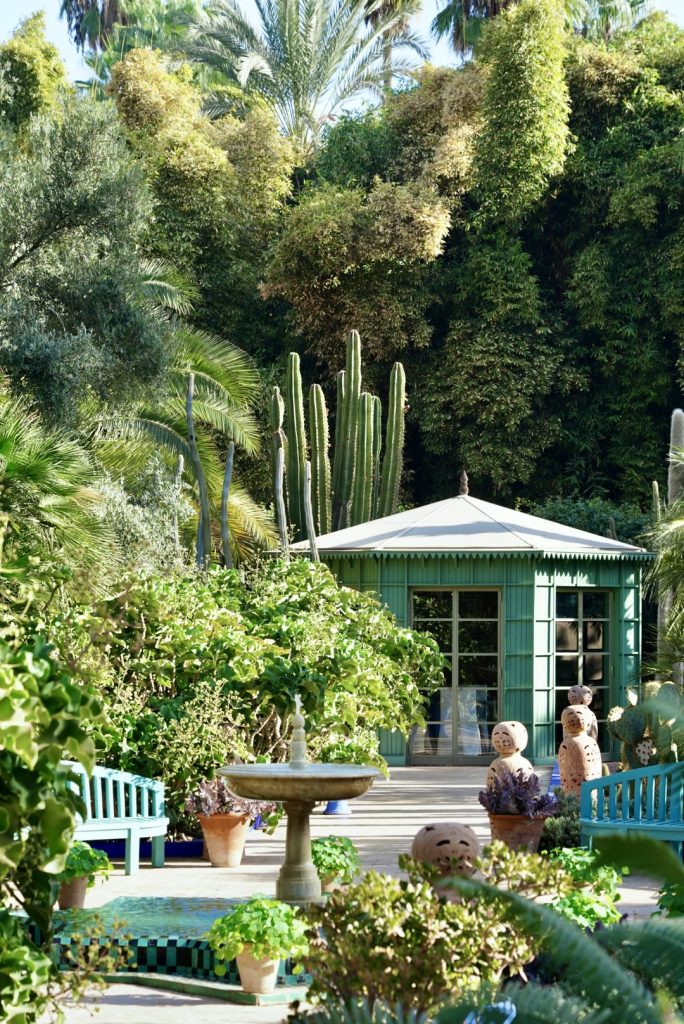
Visiting both the garden and the museum is an immersion into two legacies. The best time to visit is early morning, when the light is soft and the crowds still sparse. Pause by the lily ponds, where water mirrors palms and blue walls. Sit beneath the pergola, sip mint tea from the garden café, and let the sounds of the city melt away.
If you’re a photographer, this is your playground. Every corner is a frame, every shadow a composition. Even if you’re not, it’s impossible to take a bad photo here.
Afterward, cross to the museum for an hour or two. The exhibits are intimate, not overwhelming. They reward attention. The clothes inside look like they were cut straight from the plants outside.
The Legacy of Majorelle Garden and the Yves Saint Laurent Foundation in Marrakech
Pierre Bergé continued to care for Majorelle Garden until his death in 2017. Before he passed, he ensured its future by transferring ownership to the Fondation Pierre Bergé–Yves Saint Laurent, which still manages it today. Their stewardship keeps the garden open to visitors from around the world, with proceeds supporting cultural and educational initiatives in Morocco.
Majorelle Garden doesn’t feel like a monument to two famous lives. It feels like a backyard someone loved enough to keep alive for everyone else. It remains deeply Moroccan, rooted in local craft and tradition, yet global in its resonance.
For travelers, it’s a reminder that beauty often survives because someone cared enough to restore it.
Experiencing Marrakech
A visit to Majorelle Garden and the Yves Saint Laurent Museum is best seen as part of a wider conversation with Marrakech itself. From the museum, it’s a short taxi ride or a pleasant walk to the medina. There, the colors multiply: ochre walls, green-tiled minarets, piles of saffron and indigo in the souks.
If you crave calm after the crowds, the Jardin Secret offers another pocket of peace in the old city. For food, seek out the women-run Amal Training Center for a meal that nourishes both body and community. And for a taste of café culture, Dar el Bacha Coffee Museum is a must. Its restored palace and curated brews are just magnificent.
Marrakech has a way of overwhelming and enchanting in equal measure. The trick is to balance both, to wander its maze, then retreat to its gardens. To immerse, then exhale.
Why Majorelle Garden Captures the Soul of Marrakech
In the end, the story of Majorelle Garden and the Yves Saint Laurent Museum is about transformation. A painter’s forgotten retreat reborn as a global icon. A designer’s personal refuge turned museum. A city that continues to reinvent itself without losing its soul.
Standing before the cobalt walls, the sunlight catching the ripples of a fountain, it’s easy to see why this place captured Saint Laurent’s heart. Here, art and life blur. Here, color becomes emotion.
And here, in this mirage in the desert, you understand what he meant when he said: “Before Marrakech, everything was black.”
If You Go
Location: Rue Yves Saint Laurent, Marrakech
Hours: Daily, 8 a.m.–6:30 p.m. (closed during midday prayer on Fridays)
Tickets: Combined entry for the garden and museum is available on-site or online through the Fondation Jardin Majorelle website.
Best Time: Early morning or late afternoon for the softest light and thinnest crowds.
Nearby: Gueliz district cafés, Dar el Bacha, and the Artisan’s Quarter for shopping.
Planning a Trip to Marrakech?
Majorelle Gardens are a highlight of Marrakech, but the Red City has plenty more to discover beyond its famous blue walls.
- The Secret Garden — a quieter retreat in the heart of the medina, with traditional Islamic garden design and beautiful architecture.
- Bahia Palace — an extraordinary example of Moroccan craftsmanship, from its intricate zellij to its carved cedar ceilings and peaceful courtyards.
- Medersa Ben Youssef — a former Islamic college renowned for its elaborate stucco, geometric tilework and cedar wood carvings.
- Jemaa el-Fnaa and the Souks — the lively heart of the old city, where food stalls, storytellers, musicians and traditional workshops bring Marrakech to life.
About the Author

Ahlam Morjani is a Tangier-based writer, aspiring psychologist, and devoted animal lover. When she’s not immersed in her work or studies, she’s exploring the intersections of cinema, philosophy, and self-development through her articles.
She loves to spend her days feeding the city’s strays that roam the medina’s narrow streets or settling into the worn velvet seats of Tangier’s old cinemas, finding profound inspiration within these spaces that resonate with her explorations into film and art, societal nuances, and the very joie de vivre of life itself.